An Impressum, also called Imprint in English, is a subpage you must prepare if you run business activities in Germany, Austria, and Switzerland and offer your services through the Internet. The obligation to have an Impressum also applies to every business registered outside Germany, Austria, or Switzerland that has a website in the German language and thus can influence the opinion of the German audience. The lack of an Impressum may result in a fine.
In this article, you will find out what an Impressum is, who needs it, where you should put it on the website, and what it should contain.
Key information
- An Impressum is a subpage required by law in countries such as Germany, Austria, and Switzerland. It’s a statement identifying the ownership and authorship of published content.
- Everyone who runs a business and legal entity that provides services in German-speaking countries or for German audiences must have an Impressum.
- An Impressum must be featured on a website, social media, and online store.
What is an Impressum?
In the English language, the word Impressum can also be called “legal notice,” “imprint,” “masthead,” or “about us page.” At least, these are its closest equivalents. The term is borrowed from press law and refers to a note containing data about the person responsible for a given content or service. It refers to a designated place where readers/users can find detailed information about the service provider.
If we wanted to quickly summarize what an Impressum is regarding running an online business, our definition would look like this.
An Impressum is a subpage that helps identify the service provider. It’s legally mandated in Germany, Austria, and Switzerland and helps identify the entity offering services and content through the Internet for the German-speaking audience. It’s also used for quick contact between an entity and a client.
It’s a short definition that we’ll expand throughout the article.
What entities are required to have an Impressum?
Every entity offering services within and outside German-speaking countries that target their content to the German audience must have an Impressum on their website.
This obligation applies to:
- Companies running an online business
- Online stores
- Blogs
- Public institutions
- Non-profit organizations
- Professions such as doctors and lawyers
- Freelancers
Private entities are free of this obligation, meaning people who, for example, run a blog for personal use and don’t earn money off of it. In other words, websites that don’t generate profit don’t have to publish an Impressum.
In turn, every entity that earns money (e.g., with paid services or ads) must have an Impressum on their website.
This also applies to foreign entrepreneurs (Americans, British, etc.) doing business in the German market, who must behave in accordance with the German Competition Act.
In which countries is it required to have an Impressum?
Legal provisions in Germany, Switzerland, and Austria require an Impressum.
The obligation to have an Impressum is described in § 5 of the German Telemedia Act (Telemediengesetz—TMG) and in w § 55 of the Interstate Broadcasting Agreement (Rundfunkstaatsvertrag—RStV). These sections indicate information that must be included in the Impressum, such as the service provider's name or contact details.
Austria and Switzerland also have legal documents regulating this issue, such as the Austrian Media Act (Mediengesetz) and Swiss Federal Law on Unfair Competition.
If your company meets the requirements of German law, you can safely assume that you also meet the requirements for Austria and Switzerland.
What information about the company should be included in an Impressum?
Impressum on a website should contain information that allows every visitor to identify the business entity quickly. Additionally, the website owner should provide information enabling them to contact the entity quickly through an e-mail or phone number.
An Impressum should contain the following information:
The name of the business owner
An Impressum must contain the full name of the person running a business. In the case of legal persons and partnerships, it’s the full name of the company, along with the specified legal form and the details of the person authorized to represent the company.
Additionally, if the website displays information about the company's capital, it should also be included in the Impressum. In this case, you should state the initial or share capital amount.
Contact information and address for service
The subpage should also contain the full address (street, house/apartment number, zip code, city, and country). For legal persons, it will be the registered business address. Providing the address of the post office box is insufficient because the business owner doesn’t reside at this address.
The Impressum should also have an e-mail address, phone number, fax, or access to the contact form. Unlike a phone number, providing an e-mail address is mandatory.
The phone number doesn’t have to be included in the Impressum if the business owner provides access to an electronic contact form that allows the user to contact the owner within 60 minutes. However, information about a phone number is considered a more professional option, so it’s worth adding it.
It’s also worth noting that if the client loses the ability to contact the company online after establishing contact, then the business owner is obligated to provide an offline way of contact, that is, a phone number.
Information on regulatory authority
If a profession requires a business license, then the Impressum should contain information on regulatory authority. This requirement also applies to companies listed in the public register (e.g., the German commercial register or the UK trade registry). You should indicate the state body keeping the register, the city, and the register number. This requirement applies to companies registered in Germany and foreign businesses registered in their country of origin (e.g., American companies registered in the USA).
If you provide information from the trade registry, you need to remember the trade register number and indicate the register court.
If the company is in the process of liquidation or dissolution, you must also include this information in an Impressum.
VAT identification number
If your business has a VAT identification number, you must include it in an Impressum. The same thing applies to business identification number.
Small entrepreneurs and companies without VAT identification numbers don't have to provide them in an Impressum. However, they need to remember to add a proper clause informing that VAT isn’t added to the prices:
“All listed prices are final prices, including delivery/shipping costs. As a small entrepreneur in accordance with § 19 UStG, we do not charge VAT; hence, this tax is not disclosed here.”
You should include this clause in the Impressum and in the place where you list the prices for services and products.
Information on regulated professions
People working in regulated professions, such as doctors or lawyers, must provide information about their profession. This information must include the professional title, the country where the title was obtained, and the legal basis for the profession.
Information related to the journalistic and editorial content
For entities offering telecommunications media services, Impressum should contain information on the responsibility for content with journalistic or editorial elements composed in whole or in fragments of written or graphic content of periodic printed works.
In this case, you need to provide the data of the person responsible: name, surname, and address.
Additional information
Companies also often provide additional information regarding copyright information or online dispute resolution platforms in an Impressum. For example, the European Commission offers a dedicated platform for dispute resolution, and you can find a link to it in the Impressum.
Penalties for the lack of Impressum
The lack of Impressum on a website can lead to financial penalties of up to 50,000 euros. Surprisingly, German companies often find warnings in their mailboxes addressed by lawyers who expect a quick profit.
In Switzerland, the penalty for the lack of Impressum isn’t specified.
In Austria, violating the legal provisions of the Media Act can result in a fine of up to 20,000 euros. Similar to Switzerland, a precise penalty for the lack of Impressum isn’t stated.
The absence of the Impressum can be reported to the authorities and organizations combating unfair market practices, European Consumer Centres, or consumer protection offices (for example, in Germany, it is Wettbewerbszentrale; in Switzerland Eidgenössisches Büro für Konsumentenfragen; and in Austria Bundesministerium für Soziales, Gesundheit, Pflege und Konsumentenschutz). Law firms also deal with this issue.
Mistakes made when filling out an Impressum
Although filling out an Impressum doesn’t seem like a big problem at first glance, website owners still make some mistakes.
The most common mistakes in an Impressum:
- The lack of complete information about the company or the person running a business.
- Forgetting to place the link to the subpage with an Impressum in an easily accessible and visible place.
- Failure to comply with the requirement to clearly describe the link leading to the Impressum.
- Mistaking Impressum with the GDPR or privacy policy.
Where should you put an Impressum on a website?
The overall provisions regarding access to Impressum state that it should always be available, easily recognizable, and immediately accessible. In other words, clients visiting the website should be able to easily and quickly find Impressum.
The placement of the Impressum is equally crucial from the legal perspective and the user experience. You can provide access to this subpage by putting the link, which must contain the word Impressum, in the website's footer or adding it to the main navigation menu. The link to the Impressum is often in the footer because it ensures that it’s accessible from any subpage. It’s important because, from the legal perspective, the link to the Impressum should be on every page of an online store or company website.
Impressum on social media (Facebook, Twitter)
German law requires business owners to publish Impressum on social media platforms such as Facebook or Twitter (X) if they use them to operate a business. Facebook makes this task easier for owners of company profiles and provides a seperate section in which they can publish the content of the Impressum.
Impressum on Facebook
To publish Impressum on Facebook, you need to take these steps:
- Click the profile picture in the top right corner.
- Click “See all profiles” and select the company’s profile.
- Click “About” below the cover photo.
- Click “Privacy and Legal info.”
- Click “Add Impressum.”
Facebook provides a space for entering information regarding Impressum up to 2,000 characters. If the content exceeds this number, the portal generates a link to view the entire Impressum.
That’s what the Impressum looks like on Alianz’s Facebook page.

Impressum on Twitter (X)
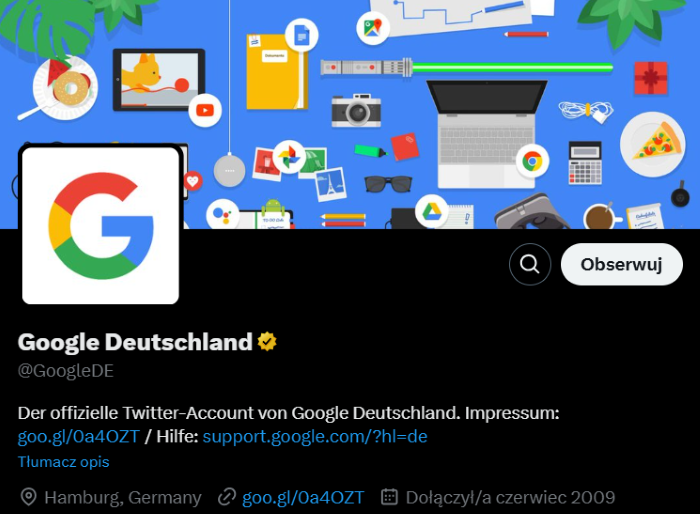
In the case of Twitter (X), you only have the space to enter a profile description. However, companies like Google solve this problem by adding a link containing the word “Impressum” and labeling it with the appropriate title (e.g., Impressum: https://www.impressum.com).
Summary
Impressum is a legal requirement for entities offering services and products in German-speaking countries (Germany, Austria, and Switzerland), and its absence can lead to financial penalties. That’s why businesses providing services for the German market should pay special attention to the Impressum and ensure that it contains complete information regulated by relevant legal basis. The website should have a clear link to the subpage with Impressum.
Business owners should also remember to publish Impressum on both a website and social media platforms in a visible and easily accessible place.
This article does not constitute legal advice; therefore, if you have questions or doubts, you should consult them with your lawyer.